Pfc. Robert H. “Bobby” Peterson
Company A, 801st Tank Destroyer Battalion • July 21, 1921 — March 2, 1945 • “Always Up”
Tank Destroyer Command
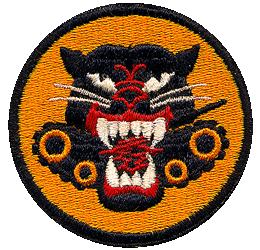
“Seek, Strike,
Destroy.”
The strategic crisis
In 1940 the world watched Nazi Germany’s Blitzkrieg smash through Western Europe. Massed panzer columns punctured weak points in infantry lines, bypassed strongpoints, and threw rear command echelons into chaos. Traditional defenses — anti-tank guns parceled out passively along static fronts — were obsolete overnight.
The American answer was a radical, specialized doctrine championed by Gen. Lesley J. McNair, head of Army Ground Forces: a dedicated Tank Destroyer Command, created in November 1941. Its insignia was a panther crushing a tank in its jaws; its operational command was three words.
“Seek, Strike, Destroy.”
Speed over armor
The tank destroyer was built on a deliberate compromise: sacrifice armor protection for absolute speed and maximum firepower. Where tanks were multi-role platforms weighed down by heavy plating, tank destroyers were single-purpose hunters. The Army calculated that American crews would outmaneuver the panzers — take a lethal shot from ambush and redeploy before the Germans could answer.
The most distinctive result was the open-topped turret. It left the five-man crew exposed to artillery airbursts, shrapnel, and snipers — but gave the commander an unobstructed 360-degree view of the battlefield, letting him spot hidden enemy armor seconds before the enemy spotted him. For the towed-gun battalions like Bobby’s, the trade was starker still: no armor at all.
Evolution of the hunt
M5 3-inch towed gun
Accurate, with a massive kinetic punch capable of piercing heavy German plating — but completely unarmored, and dependent on heavy transport to move, hook, and unhook. If a position was suddenly overrun, as Company A experienced in the snow at Honsfeld, moving a multi-ton gun under direct panzer fire was a near mechanical impossibility.
M10 Wolverine
Built on a modified Sherman chassis with sloped, thinner armor and an open turret carrying the 3-inch gun. The 801st helped develop and test it as school troops at Camp Hood — the first step away from the towed gun’s fatal immobility.
M18 Hellcat
One of the fastest tracked armored vehicles in military history, pairing lightning agility with a 76mm gun. The 801st converted to Hellcats at Immenrode in April 1945 — “Goodbye Towed, hello SPs,” as the battalion’s map put it — then raced 300 miles in two days to the Danube.
Hide, strike, flank
The ambush from defilade
Tank destroyers never charged enemy armor head-on. Crews hid hull-down behind ridgelines, stone walls, or hedgerows with only the gun barrel exposed, zeroed on a bottleneck, waited for the vulnerable side or rear armor of a panzer column to cross their sights — then fired three or four rapid armor-piercing rounds and reversed down a pre-scouted withdrawal route.
Massed mobile reserves
Battalions were held in continuous mobile reserve behind the infantry lines. When an armored breakthrough was reported, the destroyers exploited their road speed to concentrate dozens of guns at the point of the puncture, throwing a sudden crossfire web across the panzer spearhead’s path.
“Always Up” close support
In the Ardennes winter, fog and blizzards made long-range ambush impossible — so crews were pushed into the forward infantry foxhole lines, guns sited far forward, frequently under direct enemy observation, locked, loaded, and “Always Up” to break the momentum of charging SS panzergrenadiers. The battalion’s old loader’s call became, in December 1944, a literal description of where its guns stood.